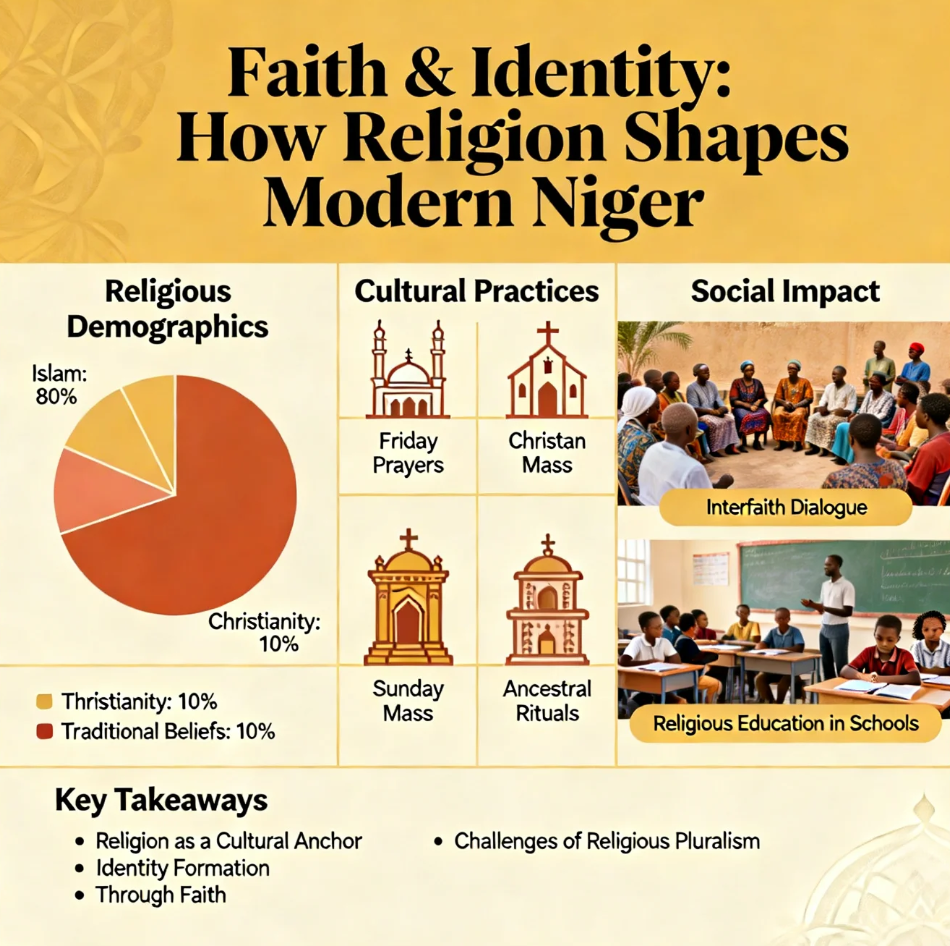
In Niger, faith is more than a belief system—it is a foundation of identity. Religion influences how communities interact, how traditions are preserved, and how people understand their place in a rapidly changing world.
To understand modern Niger, one must understand how religion shapes social values, cultural continuity, and national identity.
Religion as a Pillar of Daily Life
For many Nigeriens, religion is woven into everyday routines. Prayer, communal worship, and religious observances mark the rhythm of life across cities and rural regions alike.
Faith often guides:
- Moral values and personal conduct
- Family structures and community roles
- Social responsibility and mutual support
Rather than existing only in sacred spaces, religion is lived openly and collectively.
Islam and Cultural Continuity
Islam is the predominant religion in Niger and plays a central role in shaping social norms and traditions.
Its influence can be seen in:
- Community leadership structures
- Educational practices, including Qur’anic schools
- Festivals and religious holidays
- Concepts of charity, hospitality, and solidarity
Islam in Niger is deeply intertwined with local customs, creating a distinct expression of faith rooted in both belief and culture.
Religious Diversity and Coexistence
While Islam is dominant, Niger is also home to Christian communities and indigenous belief systems. This diversity contributes to a broader national identity shaped by coexistence rather than conflict.
In many regions:
- Religious communities live side by side
- Interfaith cooperation supports social harmony
- Shared cultural values transcend doctrinal differences
This pluralism reflects a collective emphasis on unity and respect.
Faith as Social Support and Resilience
Religion in Niger often functions as a source of resilience, particularly in times of economic hardship or social uncertainty.
Faith-based networks provide:
- Emotional and spiritual support
- Community aid and charity
- A sense of purpose and belonging
In this way, religion strengthens social cohesion and reinforces communal responsibility.
Religion and National Identity
Religion also contributes to how Nigeriens define themselves as a nation.
It shapes:
- Ethical expectations of leadership
- Public discourse on justice and responsibility
- Collective responses to social challenges
Rather than being purely private, faith informs public values and shared identity.
Modernization and Changing Expressions of Faith
As Niger engages with globalization, urbanization, and digital culture, religious expression is evolving.
Younger generations are:
- Balancing tradition with modern aspirations
- Exploring new forms of religious education
- Engaging with faith through media and technology
Despite these changes, religion remains a stabilizing force—adapting without losing its core significance.
Challenges and Conversations Around Faith
Like many societies, Niger faces ongoing conversations about:
- The role of religion in governance
- Education and religious authority
- Balancing tradition with progress
These discussions reflect a society actively negotiating how faith fits into its modern future.
Faith as a Shared Moral Language
In Niger, religion serves as a common moral framework. It helps articulate ideas of right and wrong, duty and compassion, individual belief and collective responsibility.
This shared language enables dialogue across communities and generations.
Final Thoughts: Faith as Identity, Not Division
Religion in modern Niger is not merely a marker of belief—it is a source of identity, continuity, and unity. It shapes how people live, relate, and imagine their future.
By understanding the role of faith, we gain deeper insight into Niger’s social fabric—one built not only on belief, but on shared values and collective resilience.