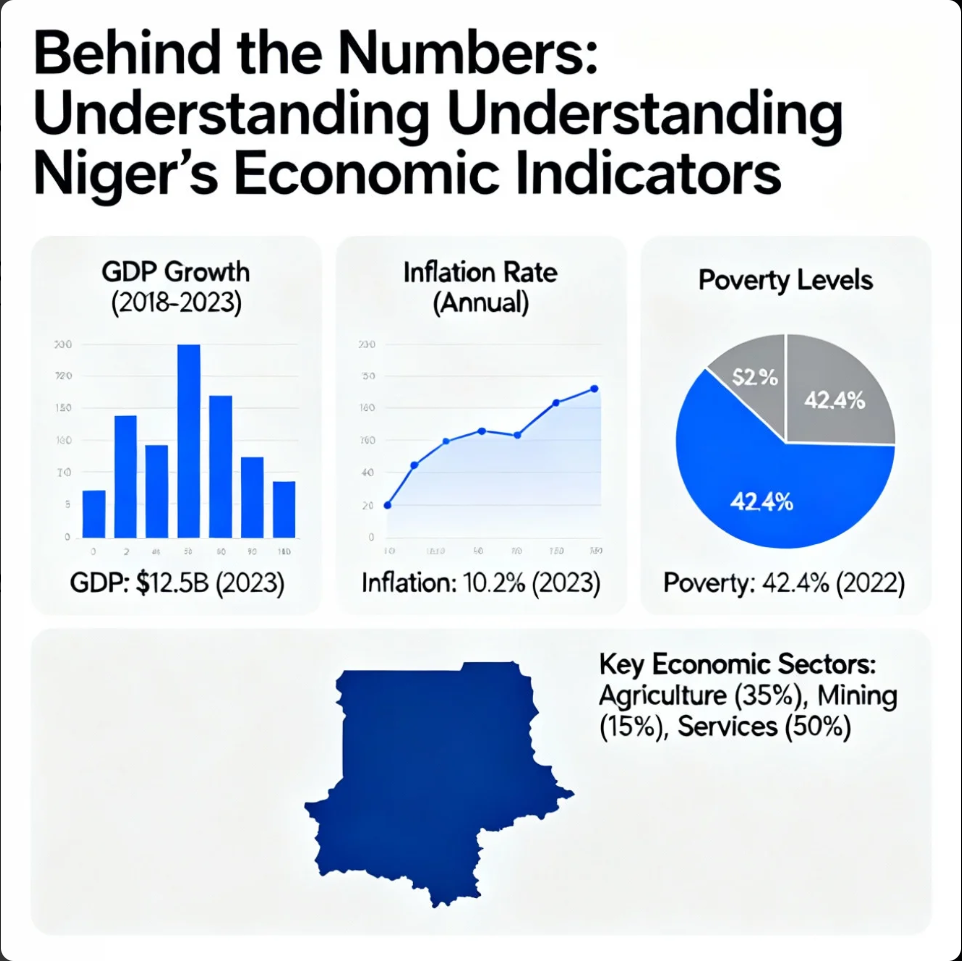
Economic statistics often appear abstract—percentages, ratios, and charts that seem distant from everyday life. Yet behind these figures lies the real story of livelihoods, growth, and resilience. To truly assess development and opportunity, it’s essential to look behind the numbers and understand what Niger’s economic indicators actually reveal.
This article unpacks the most important indicators shaping Niger’s economy and explains why they matter for policymakers, investors, and citizens alike.
Gross Domestic Product (GDP): Measuring Growth, Not Well-Being
What GDP Tells Us
GDP measures the total value of goods and services produced in Niger over a given period. Rising GDP generally signals economic expansion, often driven by:
- Agriculture performance
- Natural resource extraction (such as oil and uranium)
- Infrastructure investment
However, GDP growth alone does not guarantee improved living standards. In Niger’s case, high population growth means economic expansion must be exceptionally strong to translate into higher income per person.
🔗 Outbound link: World Bank – GDP Explained
https://www.worldbank.org/en/publication/gdp
Inflation: The Cost of Daily Life
Why Price Stability Matters
Inflation tracks how quickly prices rise over time. For Niger, inflation is particularly significant because:
- Food accounts for a large share of household spending
- Many households are vulnerable to price shocks
- Agricultural output depends heavily on climate conditions
Even moderate inflation can reduce purchasing power, making it harder for families to afford basic necessities.
🔗 Outbound link: International Monetary Fund – Inflation Basics
https://www.imf.org/en/Publications/fandd/issues/Series/Back-to-Basics/Inflation
Employment and the Informal Economy
Beyond Official Job Numbers
Employment data in Niger must be interpreted carefully. A large portion of economic activity occurs in:
- Informal agriculture
- Small-scale trade
- Family-based enterprises
Low unemployment figures do not necessarily indicate economic security. Many people are employed but earn unstable or insufficient incomes, making job quality just as important as job quantity.
🔗 Outbound link: ILO – Informal Economy Overview
https://www.ilo.org/global/topics/dw4sd/themes/informal-economy
Agriculture’s Share of the Economy
A Foundation with Fragility
Agriculture remains a cornerstone of Niger’s economy, supporting the majority of the population. Economic indicators often reflect:
- Rainfall patterns
- Crop yields
- Food security levels
Strong agricultural seasons boost growth, while droughts can quickly reverse gains. This dependence makes diversification a critical long-term goal.
Trade and External Balances
Exports, Imports, and Vulnerability
Trade indicators show how Niger interacts with the global economy. Key features include:
- Export reliance on natural resources
- Heavy imports of food, fuel, and manufactured goods
- Sensitivity to global commodity prices
Trade deficits can strain public finances, while improved export diversification can enhance economic stability.
🔗 Outbound link: African Development Bank – Economic Outlook
https://www.afdb.org/en/countries/west-africa/niger
Public Finance and Debt Indicators
Managing Growth Sustainably
Fiscal indicators—such as budget deficits and public debt—reveal how the government funds development. For Niger, balancing:
- Infrastructure investment
- Social spending
- Debt sustainability
is essential to ensure growth does not come at the expense of future stability.
Human Development Indicators
Numbers That Reflect Real Lives
Economic indicators increasingly intersect with social data, including:
- Education enrollment
- Health access
- Poverty rates
These metrics help explain whether economic growth is inclusive and whether improvements reach the broader population.
🔗 Outbound link: UNDP – Human Development Index
https://hdr.undp.org
Conclusion
Looking behind the numbers, Niger’s economic indicators reveal a story of opportunity shaped by vulnerability. Growth figures highlight potential, while inflation, employment quality, and agricultural dependence expose ongoing challenges.
Understanding these indicators in context is crucial—not just to measure economic performance, but to guide policies that turn growth into lasting development for Niger’s people.